Skip to content

Search

(Relocation Guide)

Relocation guide for newcomers to Kaunas

Moving to a new city often comes with many questions about where to start. This guide will help you settle in quickly and feel right at home in Kaunas.
Download the guide
Download the guide

About Lithuania, Kaunas, and the Kaunas Region

(About the location)

Lithuania is a young and vibrant democracy with a rich cultural heritage and captivating natural landscapes. As the largest and most densely populated of the three Baltic states, Lithuania has been a member of the European Union and NATO since 2004. It ranks 4th in the EU in terms of the share of people with a university education, fostering a society built on freedom, creativity, and innovation. Since January 2015, the official currency of Lithuania has been the euro (EUR), and the country’s time zone is GMT/UTC +2.

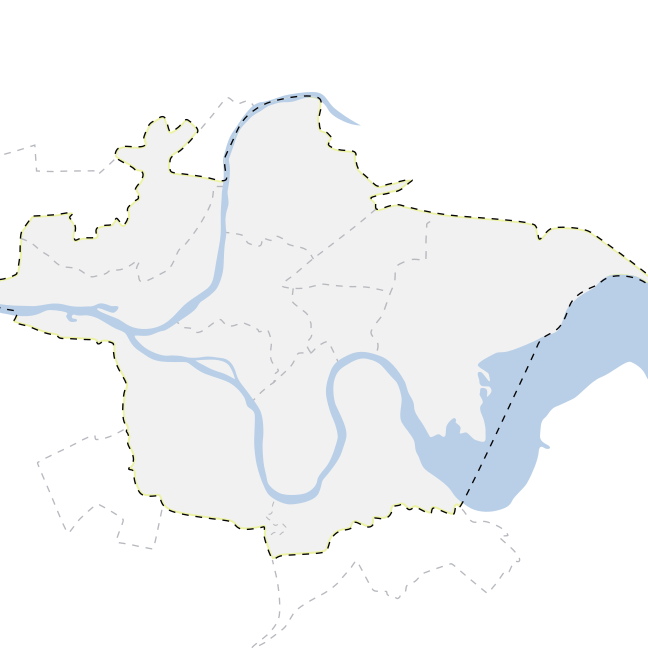
Kaunas, the second-largest city in Lithuania, is located in the heart of the country and is home to 405,000 residents (including the surrounding district). Here, history blends with modernity, offering a wide range of activities and opportunities for families, professionals, and students.

25%
Lithuania ranks among the top 25% of the safest countries.
1000+
Startups are creating a rapidly growing ecosystem.
85%
Young professionals speak English.
1
#1 in the world for publicly accessible Wi-Fi speed.
20
Lithuania is among the top 20 happiest countries globally.
(Relocation guide)

Download the full relocation guide

When arriving in a new city, many questions naturally arise about where to begin. This guide will help ensure that you settle in quickly and start feeling like a true Kaunas local.

Download the guide
Download the guide

Relocating to Kaunas or the Kaunas District

(Relocation)

Relocating to a new country involves many important considerations and tasks. To ensure a smooth transition that meets legal requirements, it is essential to manage various steps and plans efficiently. Key actions include contacting immigration authorities, preparing necessary documents, and registering your place of residence. Always rely on official information sources rather than informal channels such as friends or family.

How to obtain a visa or a temporary residence permit?

(Permits)

For information on whether you need a visa or a temporary residence permit, and for step-by-step guidance on the application process, visit migracija.lt/en and go to Service Information > Citizens of Other Countries > Staying for More Than 3 Months, then select the relevant topic for detailed instructions. Immigration procedures for students and spouses may differ, so if you are unsure, it is recommended to contact the appropriate authorities by phone or email. Explain your situation and request advice tailored to your circumstances.

National visa fee – €140. Temporary residence permit fee – €20.

What documents will you need?

(Preparation)

For all residents:

  • Passport
  • Birth certificate
  • Health insurance documents, medical records, and vaccination documents
  • Customs declaration
  • Birth certificate
  • Proof of financial means, such as bank statements, employment contracts, or documents proving financial independence (€924/month as of 2024)
  • Work or residence permit
  • Police clearance certificate (for non-EU citizens)
  • Proof of pension or retirement benefits
  • Divorce documents
  • Vehicle documents and driver’s licence

Declaring your place of residence

(Settling in)

If you plan to live in Lithuania for more than 3 months, you must declare your place of residence with the local authorities. You can do this in person while collecting your temporary residence permit, online via MIGRIS, or by visiting your local eldership/municipality office. Failing to do so will prevent you from accessing social services and benefits.

When declaring a residence in a rented home owned by another person, you will need the owner’s consent. This consent can be provided in several ways, such as a notarized statement, a signed rental agreement, visiting the eldership together with the owner, or through the e-government portal epaslaugos.lt (if submitting the declaration online). Remember that if you move to a new address, you must declare your new place of residence.

Go to MIGRIS
Go to MIGRIS
(Relocation guide)

Download the full relocation guide

When arriving in a new city, many questions naturally arise about where to begin. This guide will help ensure that you settle in quickly and start feeling like a true Kaunas local.

Download the guide
Download the guide

Settle in Kaunas

(Life in Kaunas)

Finding and moving into a new home can be both exciting and overwhelming. Whatever you may be feeling, you likely have a number of questions. Whether you are considering buying or renting, looking for a specific neighbourhood, or unsure how to handle utilities — you’ll find answers to all your questions below!

A place that suits your lifestyle

(Kaunas districts)
1
2
3
4
5
6
7
8
9

Old Town (Senamiestis)

The historic heart of Kaunas, featuring charming narrow streets, historic buildings, and cultural landmarks. The Old Town is home to many museums, centuries-old churches, and the Kaunas Castle. 

Centre (City Centre)

This vibrant district blends historic charm with modern flair. On the one hand, it’s a bustling central business hub with shopping centres, offices, cafes and diverse entertainment options. But it’s not just about commerce – Kaunas city centre recently gained recognition for its UNESCO-listed modernist architecture, adding a unique allure to its already captivating character. 

Žaliakalnis

Adjacent to the city centre and known for its green spaces, Žaliakalnis is a residential neighbourhood with a mix of mostly private homes and parks. The neighbourhood is elevated, providing scenic views of the city. 

Panemunė

Located on the left bank of the Nemunas River, Panemunė is primarily a peaceful residential area. It is more distant from the city centre but situated near one of the biggest parks in the city – Panemunės Šilas, offering residents a quieter, relaxing atmosphere. 

Aleksotas

This neighbourhood is located in close proximity to the city centre and offer a blend of residential, industrial and historic elements. 

Žemieji Šančiai

A culturally diverse and rapidly developing district located along the Nemunas River. It combines historic architecture with new housing projects, quiet residential streets, and creative urban spaces.

Dainava

Expansive residential area a little bit further from the city centre. It offers convenient infrastructure including amenities like groceries, parks, schools or kindergartens. 

Eiguliai

A peaceful and convenient residential district in the northern part of the city. Eiguliai is rich in parks, schools, medical facilities, and has easy access to public transport.

Šilainiai

One of the largest districts in Kaunas, known for its spacious residential areas and convenient infrastructure.

Your home in Kaunas

(Accommodation)

When searching for rental housing in Kaunas, you can use several different online platforms. Try popular websites such as aruodas.lt and domoplius.lt. Homerental.lt offers a tailored experience, ensuring reliability and landlords who are open to renting to international tenants.

Landlords will typically request a security deposit equivalent to 1–3 months’ rent, which is returned at the end of the tenancy if all conditions of the agreement are met.

Utilities are usually not included in the rent and may also cover common area maintenance fees. Before signing a contract and planning your budget, make sure you understand utility costs, which may vary depending on the season. Asking for previous utility bills can help you estimate your monthly expenses. Clearly define which utilities are included in the rent and which you must pay yourself, such as internet, cable TV, and electricity. Carefully review the rental contract — check details such as the address, number of rooms, rental period, utility fees, inventory list, deposit amount, and accepted payment methods. The contract should be provided in both Lithuanian and English before any deposit is paid.

Students may look for student-specific accommodation online or through university resources.

When receiving the keys, be sure to inspect the property together with the landlord, documenting any existing issues. Also ask about building rules and shared facilities, including waste management, quiet hours, recycling, bicycle storage, and more.

Educational institutions

(Education)
Kindergartens

Pre-primary education provided in nurseries and kindergartens is available for children from birth to age 6. Both public and private institutions are available, and prices vary. In public institutions, the average cost is €60 per month, while private institutions range from €120 to €500, depending on the number of days attended. Registration rules are set by the municipality and typically allow up to two applications per child. The academic year begins on September 1. Applications can be submitted online via the e-services portal epaslaugos.lt or by visiting the chosen institution in person. A medical certificate must be submitted for each child every year. More information about pre-school education in Kaunas can be found at idarzeli.kaunas.lt (Lithuanian only).

Pre-school institutions offering education in foreign languages

Public:

  • Kaunas International Gymnasium – mixed groups for children speaking Lithuanian and Russian.
  • All other public kindergartens in Kaunas accept children from abroad; however, integration may be more challenging due to language barriers.

Private:

  • Eureka – kindergarten for children aged 1–5, mixed groups of Lithuanian and non-Lithuanian speakers (EN, RU). English lessons available.
  • Herojus – kindergarten for children aged 1–6, mixed groups of Lithuanian and non-Lithuanian speakers (EN, RU).
  • Istorijų Namai – kindergarten for children aged 1–6, mixed groups of Lithuanian and non-Lithuanian speakers (EN, RU).
  • Montessori Academy – kindergarten for children aged 1–3, mixed groups in Lithuanian and English.
  • Vaikystės Sodas – kindergarten for children aged 1–6, mixed groups in Lithuanian and English. English lessons available.
Preparatory classes

Pre-primary education is mandatory for children aged 6–7, and it can be offered from the age of 5 if requested by their guardians. This stage focuses on developing general skills that help children learn effectively. Admission procedures are determined by state, municipal, or private institutions. In public institutions, parents typically only contribute to the costs of meals and learning materials, and fees may be adjusted depending on the family’s situation. Pre-primary education groups may be organized in kindergartens, schools, or other educational institutions.

Schools

Primary and secondary schools cover grades 1–12, with compulsory education taking place from grades 1–10. Municipal schools are free of charge, and additional support is provided for migrant children, including an extra 30% of funding to facilitate their integration. Children who do not speak Lithuanian may attend specialized language instruction classes.

Documents from children who have studied abroad are assessed to determine the appropriate placement within the Lithuanian school system. Parents or guardians must submit an application for children under 14. Applications for public schools in Kaunas can be submitted online through the epaslaugos.lt e-government portal or directly by contacting the chosen school. More information can be found at imokykla.kaunas.lt (Lithuanian only). Some schools in Kaunas offer instruction in English — for details, consult the municipal education department or the school administration.

Public schools

  • Kaunas International Gymnasium – education for grades 0–12; separate Lithuanian and Russian language groups. Offers a Lithuanian language class for children from various countries, after which students are placed according to their language level.
  • Jurgis Dobkevičius Progymnasium – grades 0–8; bilingual Lithuanian–English groups. Most classes are taught in Lithuanian, with additional English lessons provided under the International Baccalaureate framework.
  • Kaunas Panemunė Primary School – grades 0–8; bilingual Lithuanian–English groups. Most subjects are taught in Lithuanian, with extra English lessons through the IB programme.
  • Kaunas Jonas Jablonskis Gymnasium – grades 9–12; bilingual Lithuanian–English groups in grades 9–10 and English-language IB groups in grades 11–12.

All public schools in Kaunas are prepared to admit children of returning Lithuanian diaspora families who speak at least some Lithuanian.

Private schools

  • Erudito Licėjus – an international school for grades 0–12, offering separate Lithuanian and English groups (International Baccalaureate, Cambridge).
  • Herojus – a school with three separate units:
    • Herojus Progymnasium (grades 0–8) and Herojus Gymnasium (grades 6–12) – bilingual Lithuanian–English groups.
    • Herojam Slava – grades 1–11, primarily for Ukrainian students; instruction in Ukrainian or Russian.
  • Kaunas Jesuit Gymnasium – grades 11–12; bilingual Lithuanian–English groups, integrated into the International Baccalaureate programme.

You can find more educational institutions and schools at aikos.smm.lt — the platform allows you to easily filter and sort information to find exactly what you need, in any language.

(Relocation guide)

Download the full relocation guide

When arriving in a new city, many questions naturally arise about where to begin. This guide will help ensure that you settle in quickly and start feeling like a true Kaunas local.

Download the guide
Download the guide

Work and study in Kaunas

(Work & Studies)

Kaunas, as one of the four major economic centres in the Baltic region, contributes to more than 20% of Lithuania’s GDP. Located at the intersection of the region’s key transport corridors and home to a rapidly developing Free Economic Zone, the city has experienced significant economic growth over the past seven years — most clearly reflected in an almost 100% increase in net salaries. It is one of the fastest-growing average monthly wages in the Baltics.

Diversity and inclusion

(Inclusion)

Lithuania upholds laws that ensure equality and diversity, such as the Law on Equal Opportunities for Women and Men and the Law on Equal Treatment. These laws guarantee that all individuals — regardless of gender, race, social status, religious beliefs, language, and more — are treated fairly and equally.

(Relocation guide)

Download the full relocation guide

When arriving in a new city, many questions naturally arise about where to begin. This guide will help ensure that you settle in quickly and start feeling like a true Kaunas local.

Download the guide
Download the guide

Discover your new home

(Leisure)

Kaunas offers a wide range of cultural experiences, leisure activities, and opportunities for active recreation in nature. Large public spaces — boulevards, streets, parks, and facades — together with newly opened leisure venues have transformed the face of the city over the past 10 years, significantly improving the quality of life for its residents.

Our recommendations for leisure in Kaunas

(Recommendations)

Two generations

The Soviet legacy can still be felt, but the younger generations have grown up in a free Lithuania — this blend of experiences shapes today’s diverse and modern Lithuanian identity.

Hard-working, reserved, and punctual

These qualities were shaped by various historical factors. Harsh Lithuanian winters historically required careful planning and hard work in order to survive.

Cultural identity

Lithuanians take pride in their cultural heritage and feel a strong connection to their national identity. They actively participate in collective actions, such as the Baltic Way.

Diversity and inclusion

Lithuania upholds laws that ensure equality and diversity, such as the Law on Equal Opportunities for Women and Men and the Law on Equal Treatment.

(Relocation guide)

Download the full relocation guide

When arriving in a new city, many questions naturally arise about where to begin. This guide will help ensure that you settle in quickly and start feeling like a true Kaunas local.

Download the guide
Download the guide
(Relocation guide)

Download the full relocation guide

When arriving in a new city, many questions naturally arise about where to begin. This guide will help ensure that you settle in quickly and start feeling like a true Kaunas local.

Download the guide
Download the guide
This site is registered on wpml.org as a development site. Switch to a production site key to remove this banner.